



Key takeaways
BNB Chain has proposed a new Layer 1 blockchain that allows users to interact with public DeFi applications using funds held in a shielded pool.
Private payments conceal the parties, asset and amount, while certain public contract interactions remain visible.
The proposed AtomicCall mechanism allows users to execute supported DeFi transactions without publicly revealing who owns the resulting assets.
The design includes selected BEP-20 tokens, but the available technical documentation identifies native BNB as the currently supported deposit asset.

A trader watching a decentralized exchange on BNB Chain’s proposed new network could see which contract handled a swap, how much went in and how much came back. What the trader would not necessarily be able to identify is who owns the proceeds.
That distinction is at the heart of BNB Chain’s November 26 litepaper announcement, which outlines a new Layer 1 blockchain designed to bring private financial activity into public decentralized finance.
The proposed network would operate alongside BNB Smart Chain, use BNB as its native token and allow users to move funds into a shielded pool before interacting with supported applications.
The interesting part is that BNB Chain isn’t asking decentralized exchanges to become private. It’s attempting to change how users interact with them.
What A Block Explorer Would Actually Show
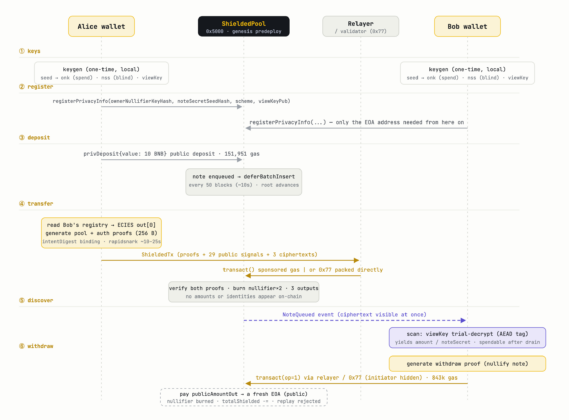
Imagine a company deposits 10 BNB into the network’s shielded pool. Anyone looking at a block explorer can see the funding address and the size of that deposit.
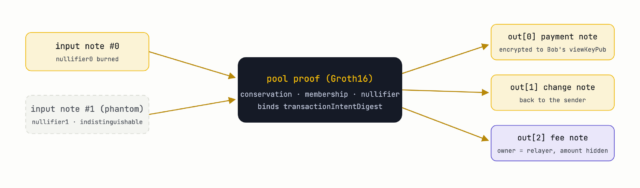
Now suppose the company sends some of that BNB to a supplier inside the pool. The network can verify the payment without publicly revealing the sender, recipient, asset or amount. Depending on how the transaction is submitted, its network fee may remain visible.
The underlying mechanism is described in BNB Chain’s technical explanation of its native privacy layer.
Instead of maintaining conventional public balances for shielded funds, the system uses encrypted records known as notes. Zero-knowledge proofs allow the network to verify that a payment is valid without exposing the financial information associated with it.
It’s a different way of accounting for money on a blockchain, not simply a feature that hides wallet addresses.
Bitcoinist previously examined how investigators traced funds linked to the Bitget breach into a Zcash shielded pool. The public deposit provided investigators with a starting point, but tracing the funds beyond that point presented additional challenges.
BNB Chain’s proposed architecture introduces another interesting dimension to that problem: interaction with public financial applications.
Private Ownership Meets Public Trading
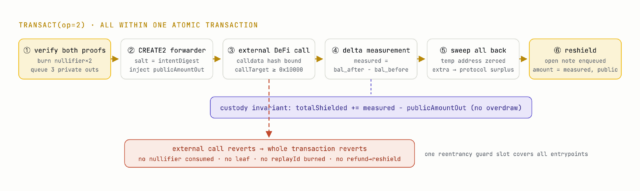
Suppose the company uses 2 BNB from its shielded balance to execute a supported swap. BNB Chain calls this mechanism AtomicCall.
The funds temporarily leave the private accounting environment, interact with a public smart contract and return to the shielded pool within the same transaction.
Anyone inspecting the public interaction could see the amount involved, the exchange contract and the instructions sent to it. The resulting assets return to the pool through what developers call an open note, which records the asset and quantity while keeping its owner concealed.
For a company that does not want competitors monitoring its treasury activity, that could be considerably more useful than conducting every transaction through a conventional public wallet.
But private ownership should not be confused with complete anonymity.
If a relatively quiet shielded pool receives an unusual deposit shortly before a corresponding public swap, observers may be able to draw connections based on transaction sizes and timing. Those clues would become less conclusive as more users and transactions enter the pool.
In other words, the effectiveness of the privacy layer may depend partly on how many people actually use it.
That’s a challenge cryptography alone cannot solve.
Which Assets Can Actually Use It?
The biggest question for BNB Chain’s proposed network may have less to do with its cryptography than with the assets it eventually supports.
The broader design includes BNB and selected BEP-20 tokens, potentially opening the door to stablecoins. However, the available developer documentation identifies native BNB as the supported deposit asset in the implementation described.
That distinction matters.
A company paying suppliers, managing payroll or settling commercial invoices is unlikely to want unnecessary exposure to cryptocurrency price volatility simply to keep its financial activity private. Stablecoins would make those use cases considerably more practical.
The project also needs to demonstrate that its cryptographic implementation is secure, including through independent review of the circuits responsible for verifying private transactions.
The most promising aspect of BNB Chain’s proposal is its attempt to bring privacy to existing financial applications instead of requiring users to abandon public DeFi entirely.
Whether that approach becomes commercially useful will depend on the assets it supports, the applications it can interact with, the security of its implementation and, perhaps most importantly, whether enough users choose to enter the shielded pool.
Publishing the litepaper is a step toward that goal. It is not yet evidence that the network has solved those problems.

Editorial Process for bitcoinist is centered on delivering thoroughly researched, accurate, and unbiased content. We uphold strict sourcing standards, and each page undergoes diligent review by our team of top technology experts and seasoned editors. This process ensures the integrity, relevance, and value of our content for our readers.


Be the first to comment